dsh-verbose
A DeepSeek Harness plugin that gives the transcript a per-chat reading mode, in the shape dsh itself lacks: the session-header 3-dots menu downloads the session log, switches each chat between Normal and Verbose, and defines what Verbose expands — thinking blocks, tool calls, terminal output.






Everything stays in the browser. Two localStorage keys — a per-chat switch and a global category set — no service, no telemetry.
Install
dsh plugin --profile web add dsh-verbose
dsh --profile web
Or from GitHub or a local folder instead:
dsh plugin --profile web add github:adithyanraj03/dsh-verbose
dsh plugin --profile web add /path/to/dsh-verbose
Restart the host afterwards — the bundle row and the governor bridge are host-side; the browser half alone is reload-only. The 3-dots menu in the session header gains the Transcript view and Verbose settings… rows.
Confirm the row:
dsh --profile web --dump-config | Select-String "id: verbose"
One line is correct; none means the bundle row was not written.
What it does
A per-chat Normal/Verbose switch
The menu replaces the built-in Session-log button — same seat, same id, lower priority — so the header still has exactly one 3-dots control. The switch applies to the open chat immediately and is remembered per session in localStorage, keyed by session id.
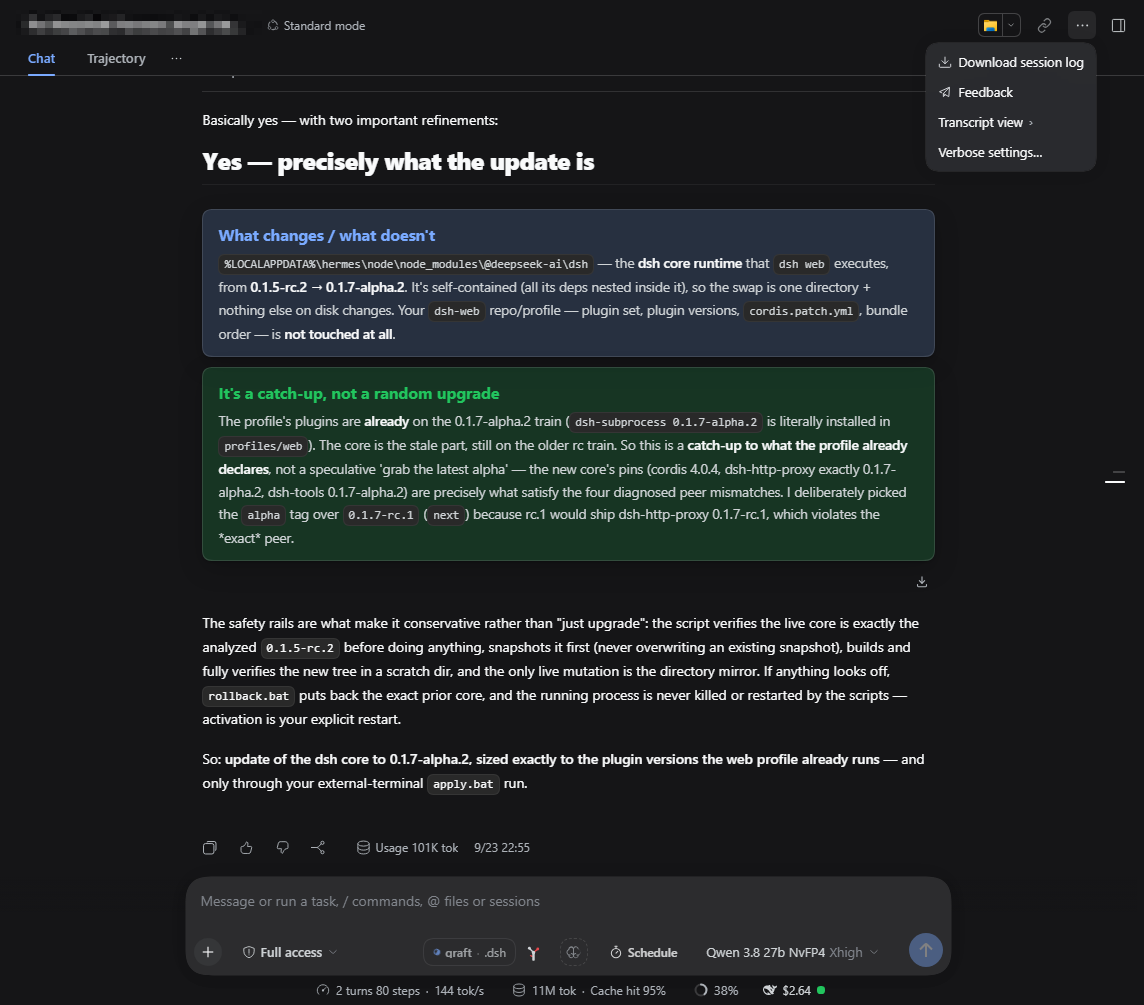
The tick shows the open chat’s current view:
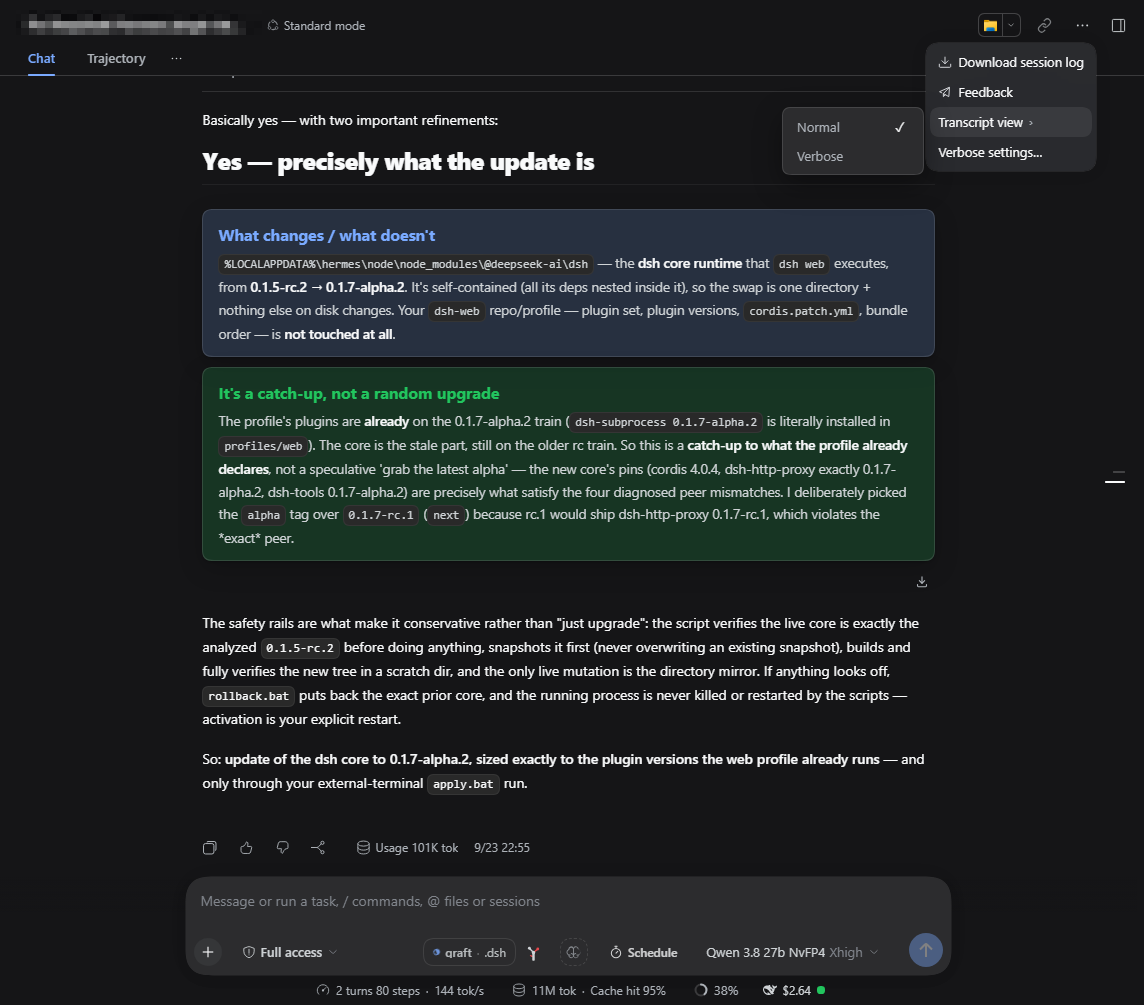
What Verbose expands
Normal leaves the transcript as dsh renders it. Verbose works the only way available from outside React: it finds every disclosure row dsh already renders, classifies it, and clicks the ones whose category is enabled — then keeps doing so for rows that arrive while an answer streams. The hooks are semantic attributes, never class hashes:
| Category | Row it governs | Selector |
|---|---|---|
| Thinking | reasoning blocks | closest('[data-variant="think"]') |
| Terminal | shell samples | closest('[data-sample="bash"]') |
| Tool calls | everything else | default |
| Step groups | the nested “Ran commands” rows inside a turn | [data-process-activity] |
Thinking is tested first, so a tool row nested inside a reasoning block counts as thinking — the enclosing kind is the one you switched off. Changing a category re-applies the open chat at once.
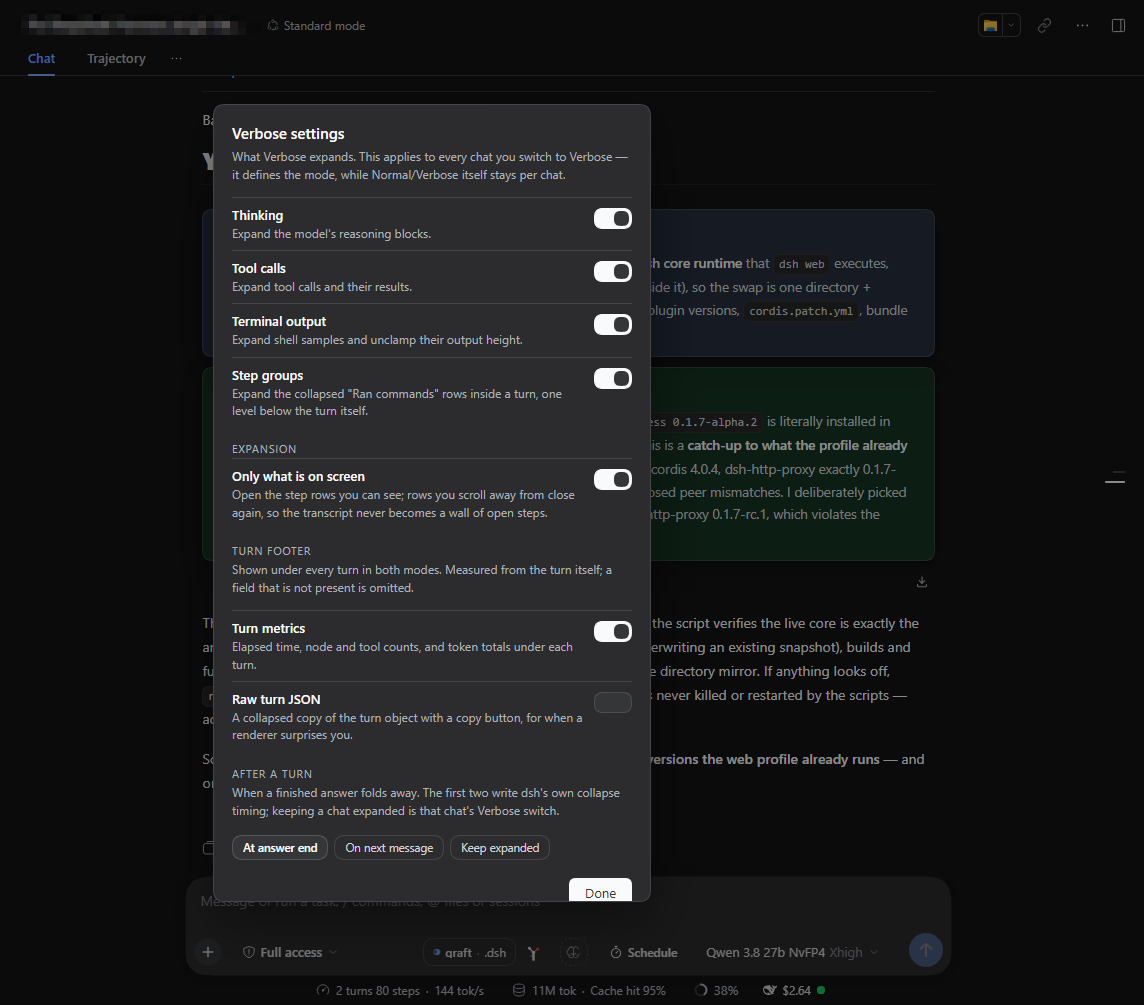
Only what is on screen
A switch decides how much work Verbose does. On (the default) opens a step row when it enters the viewport and folds it again when it scrolls out, so a long transcript never builds a wall of open steps; off opens everything enabled at once, which is what the original plugin did.
Three rules keep the mode stable, and each one exists because of a real failure:
- Two bands, not one threshold. A row must be clearly on screen (120 px inside) before it opens, and clearly gone (260 px outside) before it closes; the gap is a dead zone where the engine does nothing.
- Folding waits for the reader to stop (600 ms after the last scroll). Nothing collapses out from under a scroll in progress.
- A pass that clicked anything suppresses itself for 320 ms, so the mutations our own clicks cause cannot immediately schedule the next decision.
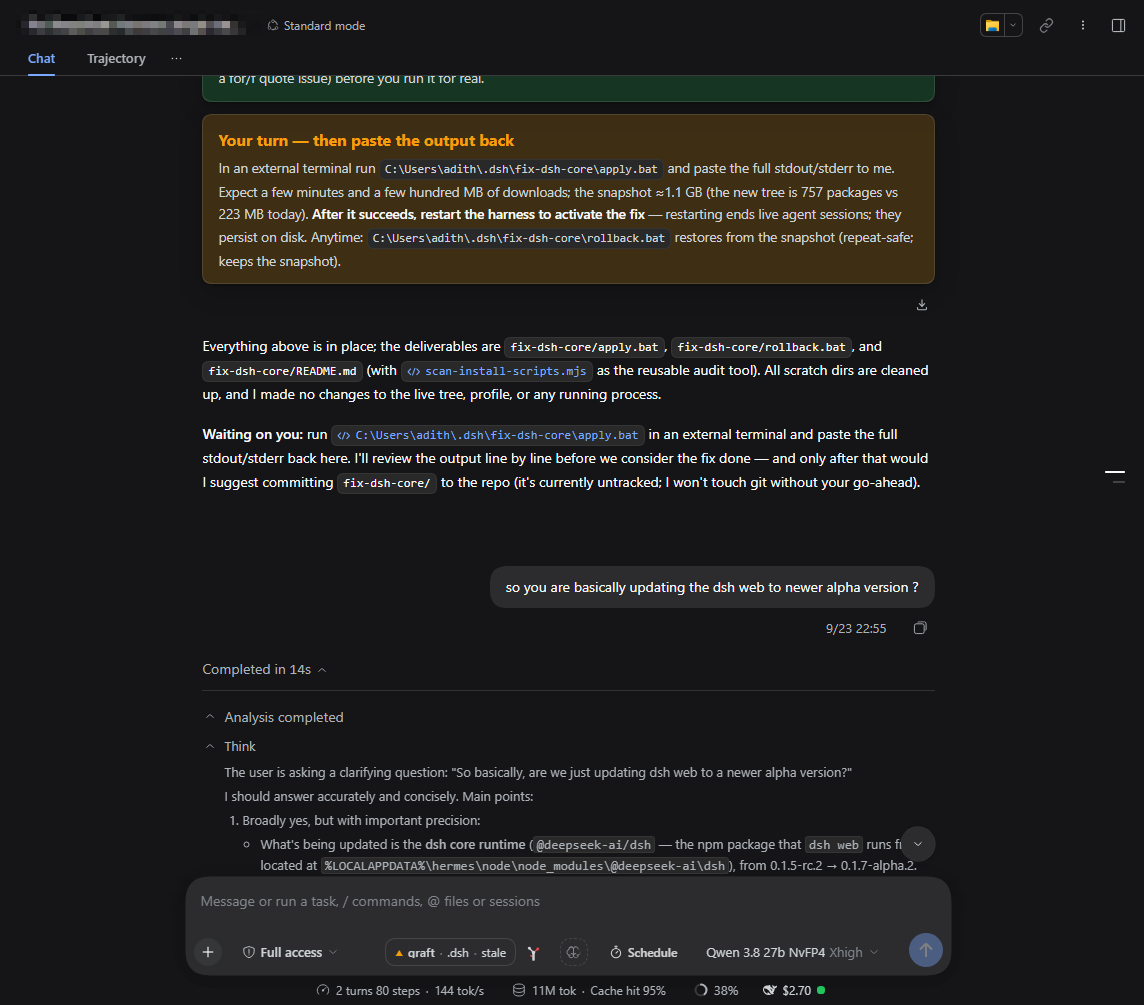
A Verbose chat, with step groups and reasoning opening as the reader scrolls:
Keyboard focus
dsh’s own disclosure rows call focus() inside their click handler, which moves the scrollport to the focused element. Two things follow from that: a synthetic click used to park focus on a row (the next Enter re-toggled it instead of sending), and — during a live generation, where every arriving tool call triggers a pass — clicking a row above the reader yanked the transcript up to it.
The fix attacks the cause and then the symptom: for the duration of each programmatic click the row’s focus is shadowed with a no-op, so focus never moves and nothing scrolls; afterwards any focus that still changed is restored with preventScroll.
A turn footer
Two switches that dsh’s renderer has no toggle for, so they are this plugin’s own node in conversation.chat.turnTail:
- Turn metrics —
⏱ 12.3s · 47 nodes · 9 tools · 84.2k tokensunder every turn, in Normal and Verbose. Everything is measured from the Turn object the slot hands over; a field that is not present is omitted rather than printed as a zero. - Raw turn JSON — a collapsed copy of that same object with a Copy button, capped so a giant turn cannot freeze the page.
They are deliberately not engine categories: the engine classifies disclosure rows, and a “metrics” row does not exist.
After a turn
The third group decides what happens to a finished answer:
| Choice | Effect |
|---|---|
| At answer end | writes dsh’s own collapseTiming: completion |
| On next message | writes dsh’s own collapseTiming: next-input |
| Keep expanded | flips this chat to Verbose — “never fold” is the per-chat toggle, not a global value dsh has |
Requirements
- dsh 0.2 (0.2.1-rc.3 tested), with a
webprofile - Node 22+
localStorage— in private mode, or with storage blocked, the choices reset on reload
Licensed MIT. Issues and pull requests at github.com/adithyanraj03/dsh-verbose.